by Alan D. Martin · Publishing November 15, 2026
Prologue
I was sitting in the galley of a liveaboard dive boat somewhere in the Bahamas when I finally got an answer.
Not from a surgeon. Not from a pain specialist. Not from the physical therapist who had spent months manipulating my knee with what I can only describe as cheerful brutality and once told me, with complete sincerity, that some people are just “puffers.” Fourteen months of procedures, referrals, and appointments, and the closest thing to a diagnosis I had received was that I was constitutionally predisposed to swelling.
The answer came from a fellow diver who happened to be a functional medicine doctor. We were on the Aqua Cat — a dive boat I’d been on before, with a group I dive with regularly. She looked at me across the galley table and said I needed to stop treating symptoms and start treating the source. She told me about a book called Good Energy by Dr. Casey Means. She explained, in the direct way that people talk on boats when the day’s diving is done and there’s nowhere else to be, that chronic inflammation doesn’t come from bad luck. It comes from what you’re putting into your body and what you’re asking it to run on.
I had heard a lot of things over the previous two years. This was the first thing that made sense.
Here’s what those two years had looked like.
I had taken most of a year off work — ready to fly anywhere, see anyone, pay anything to get the right answer. My knee surgeon was confounded. After multiple procedures the inflammation persisted, and he had no explanation for it. My back pain had grown until it eclipsed the knee pain entirely, which is saying something. A pain specialist reviewed my case and told me there was nothing more he could do, then referred me to a neurosurgeon who recommended spinal fusion. I was in my early sixties. I had, by that point, been through nearly two dozen surgeries and procedures — including nine in a single fourteen-month stretch. Some had helped. Some had not. Two surgeries, one for the back and one for the knee replacement, had made things measurably worse in ways that required further intervention to address.
I was not running out of options so much as I was running out of faith that the options meant anything.
The low point — the moment I can point to and say, that was it — was a six-hour managers meeting I sat through at work in the weeks before I took leave. About four hours in, I couldn’t feel my legs. Not pain exactly. Just absence. My manager Slacked me to ask how I was doing. From my sit/stand desk in my remote home office I messaged him back: “I can’t feel my legs.” He said he was sorry to hear that and we got back to team organizational discussions. That week I stopped working.
Which brings me back to the dive boat.
People ask — reasonably — what I was doing on a boat with fifty pounds of gear when I could barely sit through a meeting. The answer is that the water was the only place I felt normal. No pressure on the joints. No gravity grinding bone against bone. Underwater I could move. I could breathe. I could feel like a person who had a body that worked rather than one he was managing. Getting out of the water and onto the boat required some extra steps. I shed the scuba gear in the water and handed it to the deckhands as I slowly made my way up the ladder. A small indignity. Worth every bit of it.
So when my friend sat across from me in the galley and told me that the inflammation driving all of it — the knee, the back, the years of accumulated procedures — had a source that nobody had seriously addressed, I didn't feel relieved.
I felt angry.
Not at her. At the time I had spent going from specialist to specialist, each one looking at their piece of the puzzle and handing me back to someone else, nobody standing back far enough to see what was happening. The surgeons were competent at surgery. The pain specialist was competent at pain management. Nobody had asked what I was eating, how I was sleeping, or had a serious conversation about movement — about the difference between moving through pain to heal and propping your leg up with ice three times a day to manage it.
I bought Good Energy before we left the Bahamas. I read it on the flight home.
That was the beginning.
This book is what came after — two and a half years of rebuilding that followed a conversation in a boat galley with a woman who asked a different kind of question. It isn't a story about finding a miracle. It's a story about finally asking the right questions, then doing something about the answers.
You don’t need a dive trip to get there. You just need to start.
Part One
The most important move you’ll make is the decision to stop waiting.
Family came first, the job second. I worked hard, traveled more, and played hard — finding ways to push my body through tennis, weekend projects, white-water rafting, skiing, biking, motorcycles, and anything else that felt like adventure. Combine that with poor eating habits, poor sleep, and being chronically dehydrated. I only drank socially. I was very social. On the surface, I was living the life. But underneath, my body was keeping score.
By my 50s, the damage was obvious. Disks in my back were slipping, kneecaps dislocating, feet pronated — all of it preventable. Knee surgeries. Back surgeries. Stem cells. Injections. Results poor. Scar tissue that made every subsequent procedure harder. I had ice packs stacked in the freezer, chiropractors on speed dial, and every knee brace, back brace, and pain device Amazon sold. Every problem preventable. Every solution temporary. The cycle kept repeating pain → treatment → temporary relief → pain again. Now chronic.
The path I was on had a predictable destination. I didn't want to arrive there.
Nobody was going to fix this for me. I already knew it. I just hadn't acted on it yet.
What followed wasn't a protocol. It was a sequence. First, I had to decide I was leading this — not a doctor, not a therapist, not the next specialist on the referral list. Then I had to understand how habits work — because until I did, I kept fighting the wiring instead of using it. And then — the part most men skip — I had to look honestly at why the machinery had been running against me for thirty years and what it would take to retrain it.
That's it. Three things. Not a program. Not a philosophy. Three things you need to own before anything you do with food or movement or sleep will hold.
Most men go straight to the tactical — new diet, new workout, new stack of supplements. I did too, more than once. You get results for a while. Then life gets hard, motivation runs out, and you end up right back where you started wondering what went wrong. What went wrong was the same thing every time: you skipped the work underneath.
That work is Part One. Chapter One starts now.
Chapter One
Quarterback of Your Health
The flight home from the Bahamas was four hours. I spent most of it reading. By the time we landed in Denver I had a clearer picture of what had gone wrong than I'd gotten from two and a half years of specialists, procedures, and appointments. The answer wasn't complicated. But nobody had thought to look for it.
In that moment — sitting on that plane, turning pages — I realized something simple and a little uncomfortable: no doctor, no pill, no injection was going to do this for me. They could advise me, patch me up, nudge me in the right direction. But if I wanted real change, I had to take the lead. I had to become the quarterback of my own health.
Quarterbacks don't wait for plays to happen. They call the play. They take the snap. They move the team forward. That's what taking charge of your health means: you own the ball. And here's the part nobody tells you — being the quarterback doesn't mean you never get sacked. It doesn't mean every play is perfect. It means you stay in the game, learn from each drive, and keep moving down the field.
When I talk to friends my age, I hear the same line: "I know I should take better care of myself, but I'll start when…" When work slows down. When the kids are grown. When I retire. When things aren't so stressful. The problem is, "when" never comes. Life doesn't slow down. Stress doesn't magically vanish. And by the time the wake-up call arrives — a diagnosis, a surgery, a scare — it's often much harder to come back. In many cases you never get the full picture: the root cause, the predispositions, the deficiencies that have been building for years. I know, because that was me.
The longer you wait to act, the smaller your margin for error becomes. After 50, that margin shrinks fast. Sleep deprivation, poor food, lack of movement — they leave deeper marks than they did at 25. But here's the other side of that: small, intentional steps also create faster gains after 50 than most people expect. Your body is still remarkably adaptive. Give it the right inputs, and it will surprise you.
Willpower is the weakest tool in the box. Design your environment so the healthy choice is the easy choice, and you won't need to fight yourself every day to make it.
Taking charge isn't about white-knuckling your way through a better life. It's about building habits and routines that do the work for you — so that over time, the right choice stops being a fight and starts being a default.
There are three principles that underpin everything in this book. Commitment over motivation: motivation is a feeling, and feelings are unreliable. Commitment is a decision. You show up because you decided to, not because you feel like it. Small steps over big leaps: the grand overhaul always fails because it overwhelms. Small, repeatable actions build into something remarkable. And design over willpower: set up your environment so the right choice is the easy choice, and the fight disappears before it starts.
These aren't motivational concepts. They're structural ones. The difference matters.
Your Body Is Your Temple
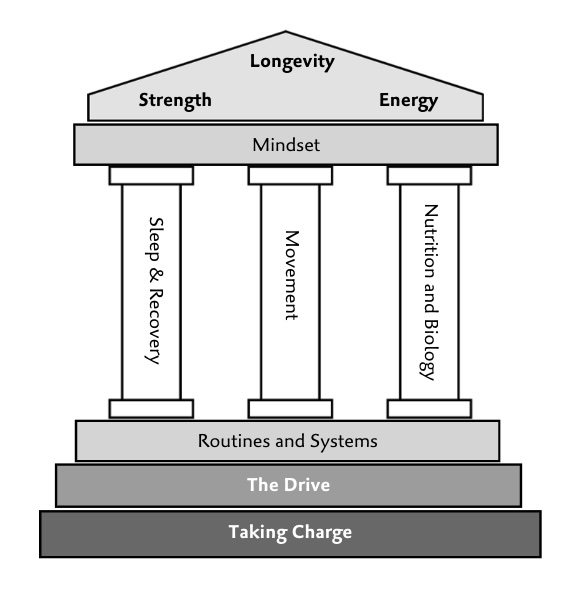
Most health programs hand you a list: eat better, move more, sleep well, manage stress. The list isn't wrong. It starts in the middle. It skips what determines whether any of it holds — and that's why most men end up back where they started.
The image above is how this book is organized. Eight elements. Each one earns its place.
Taking Charge is where it starts. The decision that no doctor, program, or pill is going to lead this. That's yours. Everything else depends on it.
The Drive is the habit machinery — the neurological wiring that runs your behavior whether you designed it or not. Understand it and you use it. Ignore it and it runs against you.
Taking Charge makes the decision. The Drive keeps it moving. Together they are the reason the habits you build stay with you — and why the men who skip these two steps, drift, and end up rebuilding the same routines every January.
Routines and Systems is where the habits become automatic. Not willpower. Design. When the right choice is the easy choice, you stop fighting yourself every day.
The three columns are the daily inputs that change your biology: Nutrition and Biology, Movement, Sleep and Recovery. Not equally urgent in every season. Not all rebuilt at once. But interdependent — each one makes the others work better, and neglecting any one of them eventually costs you in all three.
Mindset is what determines whether the columns hold when life gets hard. Not motivation. The way you interpret setbacks, manage stress, and decide who you are becoming. It is the most underestimated variable in the building.
Strength, Energy, Longevity is what a well-built life produces. Not a destination. A direction — one you return to every time life disrupts the rhythm.
Build from the base. The roof takes care of itself.
Autopilot
Let me make this concrete, because it's easy to nod along to principles and then go home and do exactly what you were doing before.
Here's what a day of reactionary habits used to look like for me. Wake up, grab the phone, twenty minutes of news and stress before my feet hit the floor — I still catch myself doing this one. Rush through breakfast: my go-to was a big bowl of Honey Nut Cheerios, because I genuinely believed they were so much better for you than Lucky Charms. I had graduated from sugary cereal to an Everything Bagel with cream cheese — my mouth is watering just writing it — plus a coffee with milk and Splenda. Afternoon crash, reach for more caffeine and sugar. Evening fatigue, collapse on the couch for a couple of shows. Late night, one more scroll before bed. None of these were decisions. They were defaults. They happened without thought, every single day, for years.
Now here's the same day rebuilt. Instead of reaching for the phone, I make the bed — first small win of the day, done before I've said a word to anyone. The dog tells me he needs to go out, which means my shoes are already at the door. I kick them off, do a few stretches in front of the koi pond, take a five-minute walk. By the time I come back in, I'm already different from when I woke up. Then hydration — lemon water with trace minerals, always before coffee, always — followed by a real breakfast built around protein. Afternoon, five minutes of stretching instead of scrolling. Evening, a ten-minute walk after dinner. Bedtime, phone in another room, one page of a book.
Still simple. Still doable. The difference is the defaults are now pulling you forward instead of holding you back.
Obstacles
The biggest barrier to taking charge isn't knowledge. Most of us already know we should eat better, move more, and sleep well. The barrier is belief — specifically, the belief that change is possible when you've tried before and failed.
I've stumbled plenty. Gone back to old habits. Had weeks where nothing seemed to work and the whole thing felt like a bad idea. Here's what I kept coming back to: you don't need perfection, you need persistence. You don't need a finish line. You need a rhythm you can sustain for the next thirty years, not just the next thirty days.
The only way you fail is if you stop showing up. Everything else is just adjustment.
This book is about building that rhythm through habits — small, sustainable, intentional routines that stack together into lasting change. You'll learn why habits outperform motivation every time, how to design them so they stick, how to remove the friction that trips most people up, and how identity — the story you tell yourself about who you are — is ultimately what makes or breaks everything. The companion workbook puts all of it into practice: it's where you apply what you're reading, track your progress, and build the personal roadmap that fits your life. Read the book to understand the approach. Use the workbook to run it.
If you're over 50, you've already learned some hard lessons. You've felt the wear and tear of years of stress, poor sleep, bad food, or inactivity. You've probably tried things that didn't work or worked for a while and then stopped. You know better than anyone that nothing about this is simple.
But you've also learned something that younger people haven't yet: how to adapt. How to take a hit and keep going. How to tell the difference between what matters and what doesn't. That experience is an asset here, not a liability.
The next chapter of your life doesn't have to be about managing decline. It can be about energy, strength, creativity, and showing up fully for the people and things that matter to you. Not by chasing some idealized version of health you saw in a magazine, but by building habits that fit your life — starting exactly where you are.
That's what this book is for. And it starts with one decision: to take charge.
You don't need a finish line. You need a rhythm you can sustain.
— End of sample. Chapter Two continues: Commitment and Why Most People Quit.